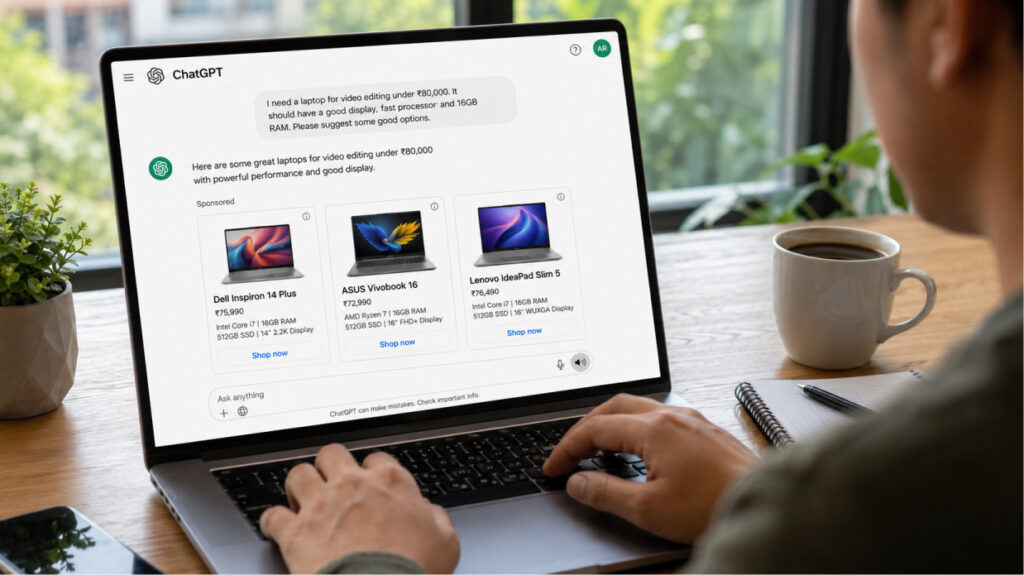
Digital advertising in India has entered a new phase.
For years, brands have built their digital advertising strategies around search engines, social media platforms, publisher networks, video platforms and programmatic advertising. Now, another major platform is entering the advertising ecosystem: ChatGPT.
OpenAI began rolling out ChatGPT Ads in India on August 27, 2026, initially making ads eligible to appear for logged-in adult users on the Free and Go plans. The initial India rollout was expected to involve more than 50 brands, marking one of the first major steps toward making ChatGPT an advertising platform in one of the world’s largest digital markets.
The rollout has moved quickly. On August 31, OpenAI announced that advertisers would be able to purchase ChatGPT Ads directly through Ads Manager in India, alongside Europe, the Middle East and North Africa. OpenAI also said ChatGPT Ads had already reached $1 billion in annualized revenue run rate globally and was being used by tens of thousands of advertisers.
For brands and marketers, this is bigger than the arrival of another advertising platform.
ChatGPT advertising introduces brands to an environment where people are not simply scrolling through content or typing a few keywords. They are explaining problems, comparing choices, researching purchases, planning decisions and asking detailed questions.
That makes ChatGPT Ads in India one of the most interesting developments in AI advertising in 2026.
ChatGPT Ads Are Officially Available in India
India is an important market for OpenAI. TechCrunch reported that OpenAI had previously said ChatGPT had more than 100 million weekly active users in India, creating a substantial potential audience for an advertising-supported model.
The first phase of ChatGPT advertising in India began with eligible users on ChatGPT Free and ChatGPT Go. OpenAI’s broader advertising policy keeps its paid Plus, Pro, Business, Enterprise and Edu plans free from ads.
The introduction of self-service Ads Manager is particularly important for advertisers. Instead of ChatGPT advertising being accessible only through a limited group of large brands, agencies and managed partnerships, businesses can increasingly create and manage campaigns directly.
OpenAI says Ads Manager now supports capabilities including CPC and outcome-optimized bidding, geographic targeting, custom audiences, product feeds, Pixel measurement and Conversions API integrations. These developments show that ChatGPT advertising is moving beyond an experimental ad format toward becoming a more complete performance advertising ecosystem.
For Indian businesses, international brands entering India and agencies managing campaigns in the market, ChatGPT Ads in India therefore represent a channel worth understanding early.
How Do ChatGPT Ads Actually Work?
To understand why ChatGPT advertising is different, it is important to understand the environment in which the ads appear.
When someone uses Google, they might search:
“Best laptop under ₹80,000.”
When using ChatGPT, the same person could ask:
“I need a laptop under ₹80,000 for video editing, occasional gaming and travelling. Battery life matters and I don’t want something too heavy. What should I consider?”
That conversation contains considerably more context.
The user’s budget, use case, preferences, limitations and purchase considerations are all expressed naturally during the conversation.
OpenAI says its advertising system can use the context of the current conversation to determine which ad may be relevant. Depending on the market and the user’s advertising settings, broader ChatGPT activity may also be used to improve relevance.
This creates an advertising environment based increasingly on conversational context.
Instead of trying to infer what a consumer might want from a limited set of signals, ChatGPT may already understand what the person is trying to accomplish because the user has explained it directly.
That is the foundation of conversational advertising.
ChatGPT Ads Do Not Influence ChatGPT Answers
One of the biggest questions surrounding advertising on ChatGPT is whether advertisers can influence the answers users receive.
OpenAI says they cannot.
According to OpenAI, ads are clearly labelled and visually separated from ChatGPT’s answers. Advertising does not determine, rank or change the response ChatGPT provides. OpenAI also states that advertisers do not receive access to users’ private conversations, chat histories, memories or personal details.
Advertisers instead receive aggregated advertising performance information such as impressions and clicks.
This distinction will be particularly important for brands exploring ChatGPT Ads. The opportunity is not to pay to become ChatGPT’s recommendation.
It is to place a relevant sponsored message alongside an appropriate conversational context while keeping the organic answer independent.
That creates a very different relationship between advertising, content and consumer trust compared with many existing digital formats.
Why ChatGPT Advertising Is Different From Google and Meta Ads
The arrival of ChatGPT Ads does not mean Google Ads or Meta Ads suddenly become irrelevant. Each platform operates in a different environment and uses different signals to connect advertisers with audiences.
A simplified way to understand the difference is:
| Advertising platform | Core advertising context | Typical user behaviour |
| Google Ads | Search queries and search intent | User actively searches for information, products or services |
| Meta Ads | Audiences, interests, behaviour and content consumption | User discovers content while browsing social platforms |
| ChatGPT Ads | Conversational context, goals and expressed needs | User explains a problem, evaluates options or works toward a decision |
The most significant difference is the depth of the interaction.
Google might know what someone searched.
Meta might understand audience interests and behavioural patterns.
ChatGPT can potentially understand what the person is trying to solve within the context of a conversation.
This is why the debate around ChatGPT Ads vs Google Ads should not simply be about which platform is “better.” The same applies to ChatGPT Ads vs Meta Ads.
For marketers, the better question is where each platform fits within the customer journey.
Search advertising remains extremely powerful when consumers express direct search intent. Social media remains valuable for discovery, audience building and demand creation. ChatGPT advertising may create an additional opportunity around research, exploration, consideration and decision-making.
Brands that understand these differences will be better positioned to decide where AI advertising fits into their overall media strategy.
ChatGPT Ads Could Change How Consumers Discover Brands
One reason marketers should pay attention to ChatGPT Ads in India is that the way consumers discover information is changing.
People increasingly use AI assistants to research products, understand complicated topics, compare options, plan travel, explore software, evaluate services and make everyday decisions.
OpenAI describes ChatGPT as an environment where discovery, consideration and decision-making can happen within the same experience. Users can explain what they want, clarify what matters to them and refine their choices through follow-up questions.
This creates a valuable environment for ChatGPT Ads for brands.
Imagine a consumer planning an international holiday.
Instead of opening dozens of search results, they may ask ChatGPT to compare destinations, estimate costs, suggest hotels, plan an itinerary and identify the most suitable travel options.
Or consider a business owner evaluating software.
They may explain the size of their business, operational problems, available budget and required features before asking which type of solution would be appropriate.
These conversations happen relatively close to real decisions.
For advertisers, appearing in a useful and relevant way during these moments could create a new form of brand discovery that sits somewhere between traditional search advertising and recommendation-driven media.
ChatGPT Advertising Cost in India: What Does the ₹725 Starting Budget Mean?
Cost will naturally be one of the first things advertisers want to understand.
When the India rollout was initially announced, TechCrunch reported that OpenAI’s Ads Manager would allow campaigns with a daily minimum budget of ₹725.
For businesses researching ChatGPT advertising cost in India, that reported entry point makes experimentation more accessible than an advertising platform restricted only to major enterprise budgets.
However, the minimum budget should not be the main reason a brand decides to advertise on ChatGPT.
The important questions are performance-related.
Can ChatGPT Ads generate qualified traffic?
How valuable is traffic coming from high-context conversations?
How effectively can advertisers measure conversions?
Which industries perform best?
How do CPCs develop as more advertisers enter the auction?
Can brands achieve a stronger return when advertising appears around deeper consumer intent?
OpenAI says CPC and outcome-optimized bidding now account for the majority of campaigns globally, while Pixel and Conversions API capabilities support measurement and optimization.
That means advertisers should approach ChatGPT advertising the same way they would approach any emerging performance channel: test carefully, establish measurement, understand audience quality and judge the platform on business outcomes rather than novelty.
₹725 a day may be enough to begin testing. ROI will determine whether advertisers continue investing.
From Attention-Based Advertising to Intent-Based Advertising
The evolution of ChatGPT advertising is part of a much larger change happening across digital media.
For a long time, much of digital advertising focused on capturing attention.
Reach more people.
Generate more impressions.
Increase views.
Build engagement.
Those metrics still matter, especially for awareness campaigns, but advertisers are increasingly looking for environments where intent is already present.
This is also why retail media has grown rapidly. Retail platforms give brands access to consumers while they are already browsing products and moving toward a purchase. IAS Media has previously explored this shift from attention toward intent in its analysis of Retail Media Networks and the changing digital advertising landscape.
ChatGPT advertising takes the intent conversation in another direction.
Instead of relying purely on what someone searched, clicked or purchased, the platform can understand what the user is actively discussing.
This could make AI advertising particularly interesting for categories where customers require significant research before converting, including technology, travel, automotive, financial products, education, B2B services, consumer electronics and other considered purchases.
SEO, AEO, GEO and AI Advertising Are Becoming Connected
The growth of ChatGPT and other AI platforms has already changed organic marketing discussions.
Brands are no longer thinking only about traditional SEO.
They are also discussing Answer Engine Optimization, or AEO, and Generative Engine Optimization, or GEO, as they consider how their brands, content and products are represented across AI-powered discovery environments.
Now paid AI advertising adds another layer.
The relationship could eventually resemble the one brands already understand from traditional search.
SEO builds organic visibility.
Paid search creates sponsored visibility.
Similarly, brands may increasingly need to think about both organic visibility across AI environments and paid opportunities within those same environments.
SEO helps brands remain discoverable through search engines.
AEO focuses on creating content suitable for direct-answer experiences.
GEO focuses on improving brand and content visibility within generative AI environments.
AI advertising gives brands another paid route to reach consumers while those consumers are interacting with AI platforms.
These disciplines should not be treated as isolated trends.
Together, they reflect a bigger change in how people discover information online.
Brands may increasingly need an integrated strategy covering traditional search, AI discovery, content authority, conversational visibility and paid AI advertising.
Why ChatGPT Ads Matter for International Brands Targeting India
India’s scale makes the launch especially relevant for international advertisers.
The country has a rapidly growing digital economy, a highly connected consumer base and enormous demand across technology, entertainment, travel, finance, e-commerce, automotive, luxury, education and consumer goods.
For global businesses, reaching Indian consumers has traditionally involved combinations of Google, Meta, digital publishers, OTT platforms, influencer marketing and large media ecosystems.
IAS Media already works with digital environments capable of reaching major Indian audiences, including the wider Times Internet ecosystem. Brands evaluating established digital advertising opportunities in India can learn more through IAS Media’s Times Internet advertising overview.
ChatGPT Ads do not replace these channels.
Instead, they add another possible touchpoint in the consumer journey.
A global advertiser could use premium publishers for reach and credibility, social media for discovery, search for direct demand capture and conversational AI advertising to engage users during research and consideration.
That broader media mix is likely to become increasingly important as digital behaviour fragments across more platforms.
Should Brands Start Testing ChatGPT Ads in India?
It is still early.
Although ChatGPT Ads has already grown significantly globally, India’s advertising market is only beginning to experience the format at scale.
That means there will be a learning period.
Benchmarks will develop.
Advertiser competition will change.
Creative best practices will become clearer.
Performance will vary significantly by sector.
Measurement strategies will improve.
And consumers themselves will become more familiar with seeing sponsored placements inside AI environments.
Brands therefore do not need to abandon established channels and move large portions of their budgets into ChatGPT advertising immediately.
But ignoring the development would be equally shortsighted.
Early testing can help brands understand the platform before it becomes crowded.
Advertisers can begin learning which conversational contexts are valuable, which messages attract engagement, how ChatGPT traffic behaves after the click and whether AI advertising adds incremental value alongside existing search, social and digital media campaigns.
The advantage may not simply belong to brands that spend first.
It may belong to the brands that learn first.
What ChatGPT Ads Mean for the Future of Digital Advertising
The digital advertising industry has repeatedly changed alongside consumer behaviour.
Search engines transformed how brands captured demand.
Social media changed how brands created discovery.
Programmatic advertising changed how audiences were bought across the open web.
Connected TV brought digital targeting into premium video environments.
Retail media connected advertising more closely to shopping behaviour.
Now conversational AI could create another major advertising environment.
ChatGPT Ads are particularly significant because they appear in a space where users are actively expressing needs.
A person may not say, “I am currently in the consideration stage of the customer journey.”
But when they spend ten minutes asking an AI assistant about different laptops, destinations, software platforms, insurance options or business services, their intent becomes visible through the conversation itself.
For marketers, this creates a new challenge.
Successful digital advertising may increasingly depend not only on understanding who the customer is or what keyword they searched, but also on understanding what they are trying to accomplish.
That is the shift brands should be watching.
How IAS Media Helps Brands Navigate the Changing Advertising Landscape
The arrival of ChatGPT Ads in India is another reminder that media strategies cannot remain static.
New platforms continue to emerge, established platforms continue to evolve and consumer attention is increasingly distributed across search, social media, publishers, streaming environments, retail ecosystems and AI platforms.
Brands therefore need to evaluate new advertising opportunities within the context of their broader objectives rather than following every new channel simply because it is trending.
IAS Media supports brands through strategic media planning, international media representation and digital advertising solutions across multiple markets and platforms. Businesses exploring how emerging channels can fit alongside established advertising opportunities can learn more about IAS Media’s digital media representation and advertising services.
The objective should always remain the same: reach the right audience, in the right environment, at the right moment, with a campaign that contributes to measurable business outcomes.
ChatGPT advertising may become an important part of that equation.
Conclusion
ChatGPT Ads are now in India, and their arrival marks an important development for brands, media buyers and digital marketers.
What makes the platform interesting is not simply that another technology company has introduced advertising.
It is the environment in which those ads can appear.
Consumers are increasingly using ChatGPT to ask questions, explore choices, compare products, solve problems and make decisions. ChatGPT Ads give advertisers an opportunity to participate in those moments through relevant sponsored placements while OpenAI keeps advertising separate from the answers generated by ChatGPT.
For brands, the opportunity now is to understand how conversational advertising differs from existing search and social channels.
Google asks marketers to understand search intent.
Meta asks marketers to understand audiences.
ChatGPT introduces a different question:
What is the customer actually trying to accomplish?
As AI advertising in India develops, that question could become increasingly important.
The brands that succeed will not necessarily be those that move the largest budgets into the newest platform. They will be the ones that understand how consumer behaviour is changing, test new channels intelligently and build media strategies that connect traditional advertising with the next generation of digital discovery.
To explore strategic digital advertising and international media opportunities for your brand, contact IAS Media and discuss how your media strategy can evolve with the changing advertising landscape.
Get in Touch With IAS Media
Experience the power of global brand building and audience engagement with IAS Media. Let’s connect and elevate your brand’s presence together.