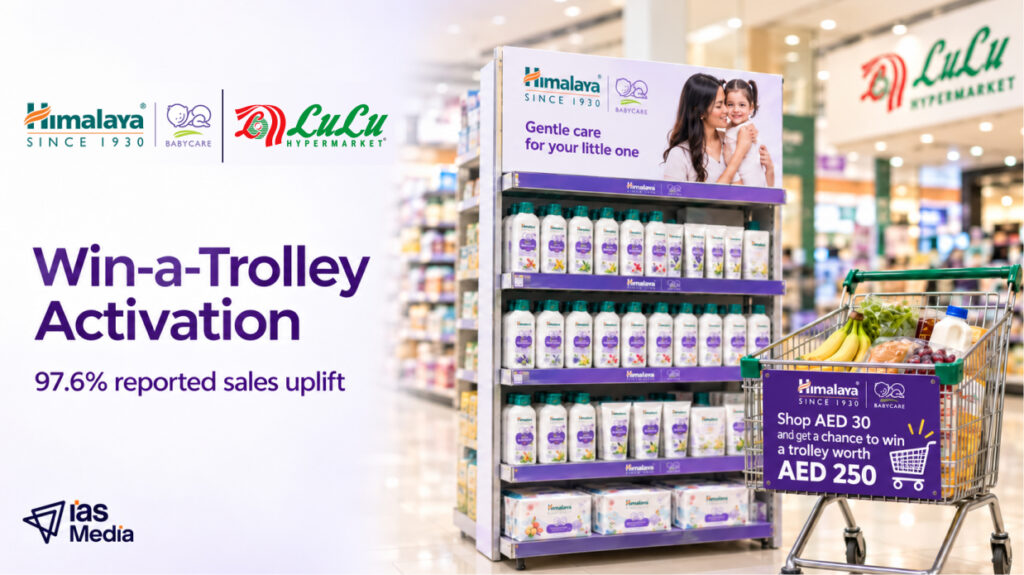
An effective retail activation gives shoppers a clear reason to notice a brand, explore its products and make a purchase. For Himalaya Baby Care, IAS Media brought these actions together through the Win-a-Trolley campaign at participating LuLu Hypermarket stores.
Created for Himalaya Wellness METAP in collaboration with LuLu Retail, the campaign combined in-store branding, shopper engagement, digital amplification and influencer support. The offer was easy to understand: purchase AED 30 worth of Himalaya Baby Care products for a chance to win an AED 250 shopping cart.
According to IAS Media’s campaign summary, the activation recorded a 97.6% overall sales uplift, with 44 winners across two activation weekends. The campaign paired brand visibility with a relevant purchase incentive at the point of decision.
Campaign at a glance: IAS Media supported the Himalaya Baby Care LuLu activation through coordinated retail and digital touchpoints. Branded displays brought attention to the range, social and influencer content supported awareness, and the Win-a-Trolley offer gave shoppers a reason to participate.
Planning a similar campaign? Contact IAS Media to discuss your retail activation brief.
Why the Back-to-School Season Called for a Shopper Marketing Activation
The back-to-school period gave Himalaya Baby Care an opportunity to connect with families during a busy shopping season. It also presented a challenge: the brand needed to stand out while shoppers were considering competing products and promotions.
The campaign brief identified four priorities:
- Increase the visibility of Himalaya Baby Care products in-store.
- Encourage shoppers to explore the baby-care range.
- Drive incremental purchases.
- Create a rewarding experience for families.
The Win-a-Trolley idea connected those priorities to the shopping trip itself. A shopping-cart reward had an immediate relationship with the environment in which the promotion appeared. Shoppers could see the products, understand the qualifying purchase and recognise the value of the prize in the same setting.
This made the promotion a useful fit for a back-to-school retail campaign. The seasonal context attracted attention, while the purchase mechanic kept the focus on Himalaya Baby Care.
IAS Media’s Role in the Himalaya Baby Care LuLu Activation
IAS Media helped bring the campaign’s physical and digital elements into a coordinated shopper experience. The work connected the brand’s commercial objective with the places where people encountered, considered and purchased its products.
The activation combined retail visibility inside LuLu Hypermarket with social amplification and influencer content beyond the aisle. English and Arabic communication carried the campaign message across these touchpoints.
For a brand team, coordination matters because an offer must remain recognisable from one encounter to the next. A shopper who sees a social post should be able to identify the same brand and promotion when approaching the display in-store.
Brands considering LuLu Hypermarket advertising can work with IAS Media to explore suitable retail placements and supporting digital opportunities around their own campaign objectives.
Campaign Overview
| Campaign element | Execution |
| Brand | Himalaya Baby Care, under Himalaya Wellness METAP |
| Retail partner | LuLu Retail and participating LuLu Hypermarket stores |
| Activation partner | IAS Media |
| Seasonal context | Back-to-school shopping |
| Promotional mechanic | Purchase AED 30 worth of Himalaya Baby Care products for a chance to win an AED 250 shopping cart |
| Selection method | Automated selection system, as described in the campaign summary |
| In-store formats | Gondolas, end caps, floor graphics, category branding, digital screens and shopper engagement |
| Digital support | LuLu social media amplification, influencer content and pre-activation awareness |
| Communication | English and Arabic |
| Reported outcome | 97.6% overall sales uplift and 44 winners across two activation weekends |
How the Win-a-Trolley Activation Worked
A Clear Qualifying Purchase
Shoppers purchased AED 30 worth of Himalaya Baby Care products at participating LuLu stores to qualify for a chance to win. The spending requirement placed the baby-care range at the centre of the promotion.
This gave the in-store communication a specific job: explain the offer close to the products shoppers needed to purchase. The display could introduce the range and the promotional opportunity together, reducing the amount of information a shopper had to piece together.
A Chance to Win Through Automated Selection
The campaign used an automated selection system to give qualifying shoppers an instant chance to win. The reward was conditional on selection; it was not a guaranteed benefit for every AED 30 purchase.
That distinction is part of clear promotional communication. Shoppers needed to understand both the purchase requirement and the opportunity attached to it, with consistent wording across the store and digital content.
An AED 250 Shopping-Cart Reward
Selected winners received an AED 250 shopping-cart reward. The campaign summary records 44 winners, compared with 40 originally planned, and includes photographs of reward presentations at LuLu Hypermarket.
Those presentations completed the shopper experience. The offer began as a reason to engage with Himalaya Baby Care and became a tangible reward for the selected participants.
In-Store Branding That Connected Visibility with Product Choice
The Himalaya Baby Care campaign placed the brand across several parts of the retail environment. Each placement supported a different moment in the shopping journey, from noticing the campaign to finding and considering the range.
Gondolas and End Caps
Branded gondolas and end caps gave the products a prominent presence in-store. Himalaya Baby Care products were grouped within a consistent visual identity, with branding positioned above and around the range.
For an in-store brand activation, this arrangement helps connect the promotional message with the products on sale. Shoppers can move from noticing the display to examining the range without having to search for a separate product location.
Floor Graphics and Category Branding
Floor graphics and category branding extended the campaign beyond the main display. These placements created additional opportunities to encounter the brand while moving through the relevant shopping area.
Their role was complementary. The main display presented the range, while nearby branding reinforced recognition around the category. Using related creative across those surfaces helped the promotion remain visually consistent.
Digital Screens
Digital screens added another layer of visibility within the retail environment. A large screen carried Himalaya Baby Care creative above the shopping area, bringing the brand into view as customers moved through the store.
This brought the brand into view beyond the immediate shelf position. Within the wider retail activation, screen visibility supported the product displays and other in-store materials.
Shopper Engagement Around the Offer
The promotion linked visibility to a clear action: purchase qualifying products for a chance to receive the shopping-cart reward. This is where the shopper marketing approach became commercially relevant. The campaign message gave shoppers something specific to consider while they were already in a purchasing environment.
IAS Media’s retail media advertising services provide a wider context for planning these connections across physical stores and digital retail channels.
Digital Amplification and Influencer Support Beyond the Aisle
In-store visibility was supported by communication outside the product display. LuLu social media activity, bilingual creative and influencer content extended the campaign’s presence and helped introduce the promotion before the activation.
LuLu Social Media Amplification
LuLu’s social channels provided another setting for shoppers to encounter the Himalaya Baby Care promotion. Social stories carried the brand, the AED 30 purchase message and the opportunity to win a shopping cart.
Keeping that central offer consistent was important to the campaign design. A social post and an in-store display served different moments, but both directed attention towards the same purchase-linked promotion.
English and Arabic Communication
The campaign used English and Arabic communication across its digital activity. The creative retained the core elements of the offer while presenting it in both languages.
For retail marketing in the UAE, this case illustrates how language planning can form part of the activation from the outset. The task is to make the purchase requirement and reward opportunity understandable wherever the shopper first sees them.
Influencer Content in a Shopping Context
Influencer support added a more personal presentation of the campaign. Content set within the store connected the product range with a family shopping occasion.
That context was relevant to the brief. The campaign addressed families buying baby-care products, so shopping content offered a natural setting in which to show the range and promotion.
Brands exploring influencer marketing in the UAE can discuss how creator selection, language and content formats should support their retail objectives.
From Attention to Purchase and Reward
The campaign’s shopper journey connected five stages:
| Stage | Campaign touchpoint | Role in the journey |
| Attention | Social content, influencers and digital screens | Introduce the brand and promotional opportunity |
| Engagement | Gondolas, end caps, floor graphics and category branding | Bring the range and offer into consideration |
| Purchase | AED 30 qualifying spend on Himalaya Baby Care products | Link participation to a product purchase |
| Selection | Automated selection system | Give qualifying shoppers a chance to win |
| Reward | AED 250 shopping carts for selected winners | Deliver the promised benefit to winners |
The same offer connected these different ways of discovering and participating in the activation. Whether shoppers first encountered a social post or an in-store display, the campaign led towards the qualifying purchase and reward opportunity.
Campaign Results with 97.6% Overall Sales Uplift
IAS Media’s campaign summary reports the following outcomes for the Himalaya Baby Care LuLu activation:
| Measure | Reported result |
| Overall sales uplift | 97.6% |
| Activation period | Two activation weekends |
| Winners | 44 |
| Originally planned winners | 40 |
| Shopping-cart reward | AED 250 per selected winner |
The reported uplift captures the campaign’s commercial outcome. Alongside it, the winner count shows that the reward programme reached real participants during the activation.
The 97.6% uplift is reported for the campaign overall. It should be read as the campaign’s stated sales result, rather than a separate performance figure for influencers, social posts, screens or individual stores.
Together, the reported results and execution details provide a concrete example of a retail promotion supported by several coordinated marketing channels.
What UAE and GCC Brands Can Learn from This Retail Activation
The Himalaya Baby Care campaign offers practical lessons for teams planning shopper marketing in the UAE and wider GCC. Brand teams can adapt its approach to their own audiences, retailer partnerships and promotional objectives.
Make the Purchase Requirement Easy to Understand
The offer paired a defined purchase amount with a clearly stated prize opportunity. Brands planning an FMCG brand activation can apply the same principle by making the qualifying products, spending requirement and participation conditions easy to identify.
Choose a Reward That Fits the Shopping Occasion
A shopping-cart reward related directly to the hypermarket visit. The broader lesson is to consider what the intended audience would value in that setting, then build the offer around it.
Keep the Brand Visible Near the Decision
The campaign combined wider awareness with branding around the product range. This gives retail teams a useful planning question: once someone has heard about the offer, how easily can they recognise it and find the qualifying products in-store?
Coordinate Seasonal Media with Store Execution
Social and influencer activity supported the same promotion shown in the retail environment. For further planning context, explore IAS Media’s guide to back-to-school advertising with LuLu Hypermarket.
Planning a Similar Retail Activation with IAS Media
A campaign brief should connect the commercial goal, retailer environment and shopper incentive before individual formats are selected. It should also establish how results will be measured, so the final evaluation answers the questions the brand set at the start.
Define the Objective and Shopper Audience
Start with the product range, intended shoppers and desired action. A new-product launch may need discovery and trial, while an established range may need stronger visibility or a purchase incentive during a seasonal period.
Agree the Retail and Digital Plan
Identify the participating locations, campaign dates, suitable in-store placements and supporting digital content. The brief should explain how each element helps shoppers understand or act on the promotion.
Set the Budget Around the Full Campaign
A retail activation budget should account for the selected placements, creative production, installation, activation support, reward allocation and any influencer or digital activity. The scope determines the proposal; the reward value alone does not represent the total campaign cost.
Establish Reporting Before Launch
Agree the sales comparison period and the definition of uplift before the campaign begins. Decide which engagement, participation and reward measures will also be available, and distinguish overall campaign results from any channel-level reporting.
| Planning requirement | What the brief should establish |
| Commercial objective | The purchase or engagement behaviour the campaign should support |
| Products and audience | Qualifying range and intended shoppers |
| Retail scope | Participating stores, timing and available placements |
| Promotional offer | Purchase requirement, reward, selection process and clear participation terms |
| Creative and amplification | Store materials, languages, social content and influencer requirements |
| Budget | Media, production, activation support, rewards and additional agreed costs |
| Measurement | Sales baseline, reporting period and available participation data |
Contact IAS Media with your product range, preferred timing, target locations and budget to start developing a campaign proposal.
The Partnerships Behind the Campaign
The activation brought together Himalaya Wellness METAP, LuLu Retail and IAS Media around a shared shopper experience.
IAS Media thanks Nisha Ganapathy and Sachin Arya from the Himalaya Baby Care team for their trust, and the LuLu Hypermarket team for its collaboration and support. Special recognition also goes to Zameer Hassan and Sneha Mathai from IAS Media for their work in bringing the activation to life.
That collaboration connected the product offer, retail setting and campaign communication through to the reward experience.
Turn Your Next Retail Promotion into Shopper Action
The Himalaya Baby Care Win-a-Trolley campaign shows how a clear offer can connect store visibility, product consideration and a rewarding shopping experience. Its reported 97.6% overall sales uplift gives the case study a measurable commercial outcome, supported by a campaign that brought physical and digital communication together.
For brands planning their next retail activation, the starting point is a relevant offer and a clear understanding of where shoppers will encounter it. IAS Media can help develop that idea into an integrated retail campaign.
Contact IAS Media to discuss a shopper marketing campaign for your brand.
Frequently Asked Questions
What was the Himalaya Baby Care Win-a-Trolley campaign?
It was a shopper marketing activation delivered by IAS Media with Himalaya Wellness METAP and LuLu Retail. Shoppers purchasing AED 30 worth of Himalaya Baby Care products at participating LuLu stores received a chance to win an AED 250 shopping cart through an automated selection system.
What results did the LuLu Hypermarket activation achieve?
IAS Media’s campaign summary reports a 97.6% overall sales uplift and 44 winners across two activation weekends. The uplift is an overall campaign result, not an individual channel’s return on investment.
Which in-store advertising formats supported the campaign?
The activation used gondolas, end caps, floor graphics, category branding, digital screens and shopper engagement. These formats brought the Himalaya Baby Care range and promotion into different parts of the retail environment.
How did social media and influencers support the activation?
LuLu social media amplification, English and Arabic communication, influencer content and pre-activation awareness supported the in-store campaign. They provided additional ways for shoppers to encounter the brand and the offer.
Was the shopping-cart reward guaranteed with every purchase?
No. The qualifying AED 30 purchase gave shoppers a chance to win through an automated selection system. The AED 250 shopping-cart reward was awarded to selected winners.
Can IAS Media help plan a similar shopper marketing campaign?
Yes. IAS Media supports shopper marketing, retail activations, influencer marketing, digital amplification and experiential campaigns. Brands can share their objectives, product range, target locations and timing to discuss a suitable activation plan.
Get in Touch With IAS Media
Experience the power of global brand building and audience engagement with IAS Media. Let’s connect and elevate your brand’s presence together.