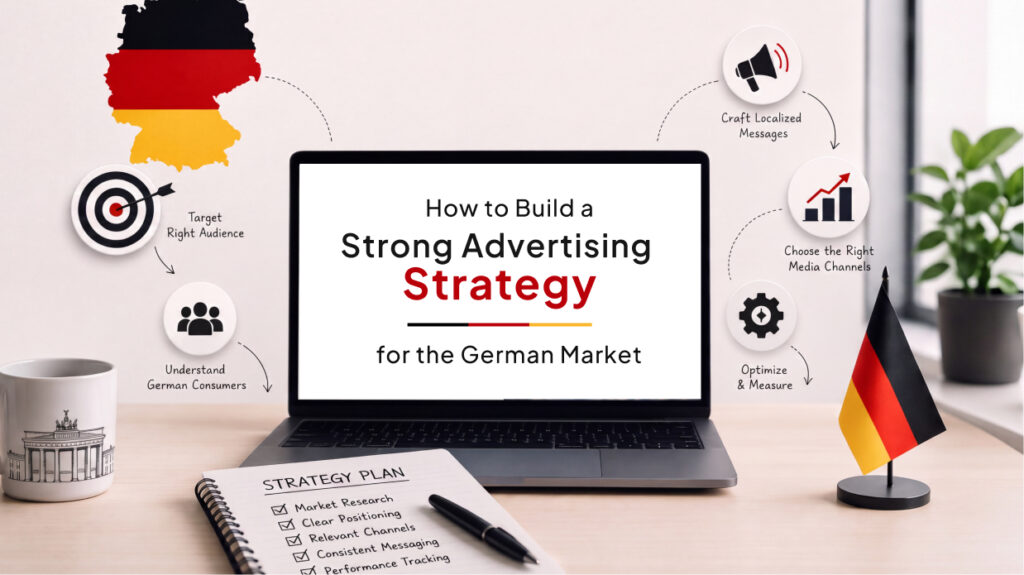
Germany is Europe’s largest economy and one of the most sophisticated advertising markets in the world. With more than 84 million consumers, a highly educated population, and strong purchasing power, the country offers significant opportunities for international brands seeking long-term growth.
However, succeeding in the German market requires more than simply translating an international campaign into German. Consumers value quality, credibility, trust, transparency, and factual communication, making a carefully planned and localized advertising strategy essential.
A successful advertising strategy for the German market combines market research, audience segmentation, the right media mix, compelling creative execution, and continuous performance measurement. While digital advertising continues to play an important role, Germany remains a major market where premium newspapers and magazines can provide valuable reach and credibility, particularly when targeting business leaders, executives, professionals, and decision-makers.
For international brands planning to advertise in Germany, understanding how German audiences consume media and what builds trust is an important starting point.
1. Understand the German Consumer
Before investing in advertising in Germany, businesses need to understand the characteristics, expectations, and purchasing behaviour of German consumers.
German audiences tend to be analytical buyers who value transparency, reliability, product quality, and useful information over exaggerated marketing claims. Consumers often research products and services extensively before making purchasing decisions and appreciate advertising that gives them enough information to compare available options.
Trust is therefore an important purchasing factor. Brands that communicate clearly, demonstrate expertise, and provide evidence of quality are more likely to build lasting credibility than businesses relying entirely on highly promotional messaging.
Localization is equally important. While many consumers and business professionals in Germany understand English, professionally localized advertising that reflects German language, culture, expectations, and market standards can create stronger engagement.
This is particularly relevant for international companies entering the German advertising market for the first time. Campaign messaging should feel appropriate for Germany rather than appearing to be an international campaign that has simply been translated.
2. Define Clear Campaign Objectives
Every advertising strategy should begin with clearly defined and measurable objectives.
These may include:
- Increasing brand awareness
- Generating qualified leads
- Driving online sales
- Launching a new product or service
- Strengthening brand reputation
- Entering a new German region
- Reaching a specific German industry
- Building awareness among business decision-makers
Clearly established goals help determine budget allocation, media selection, campaign messaging, advertising formats, and success metrics.
For example, a B2B company entering Germany may prioritize awareness and credibility among executives and corporate decision-makers. An e-commerce retailer, meanwhile, may place greater emphasis on website traffic, conversions, customer acquisition, and measurable return on advertising spend.
Campaign objectives should therefore be established before selecting advertising platforms. This makes it easier to choose media according to the audience and business outcome rather than selecting channels based only on popularity.
3. Segment Your Target Audience
Germany is a diverse market with different demographic groups, industries, regions, interests, and consumer behaviours.
Effective audience segmentation should consider factors such as:
- Age
- Income
- Profession
- Geographic region
- Industry
- Lifestyle
- Purchasing behaviour
- Digital habits
- Professional responsibilities
- Media consumption
For B2B marketing in Germany, identifying relevant decision-makers within specific industries is particularly important. Corporate executives, business owners, investors, policymakers, entrepreneurs, and professionals may consume very different media from general consumer audiences.
Premium business and news publications can therefore become valuable advertising environments when a campaign needs to reach influential professional audiences.
Print continues to hold particular significance among German decision-makers. Portfolio research indicates that 82% of decision-makers consider print the most important media type for their professional activity. Around half of decision-makers also prefer reading longer content on paper, with this preference being especially evident among people aged 50 and above.
For international brands targeting senior professionals, understanding these consumption patterns can help create a stronger German media advertising strategy.
4. Build an Integrated Media Mix
An effective German advertising strategy should rarely depend on a single advertising channel.
Instead, businesses can combine different media formats to create multiple touchpoints throughout the customer journey.
Digital Advertising
Digital advertising remains important for brands looking to reach German consumers and professional audiences through targeted campaigns.
Common digital channels include:
- Search advertising
- Display advertising
- Social media campaigns
- Programmatic advertising
- Email marketing
- Video advertising
- Native advertising
- Online publications
Platforms such as Google, LinkedIn, Meta, and YouTube can help businesses target audiences while providing measurable campaign data.
Digital campaigns can be particularly valuable when businesses need demographic, geographic, interest-based, behavioural, or professional audience targeting.
Print Advertising
Despite continued digital growth, premium print advertising maintains distinct advantages within the German media market.
German newspapers and magazines collectively reach approximately 57.5 million people every week according to the portfolio data used for this campaign planning context.
Print can provide three important advantages:
- Strong weekly audience reach
- High cognitive recall
- Credibility within established editorial environments
Research highlighted in the portfolio also indicates that print advertisements can achieve strong recognition because of how readers process physical publications. Newspaper and magazine advertising is frequently perceived as informative, useful, credible, and capable of inspiring purchasing decisions.
For brands targeting executives, investors, policymakers, professionals, or affluent consumers, premium German publications can therefore remain an important component of an integrated media strategy.
International advertisers exploring this approach can consider IAS Media’s German media portfolio when evaluating print, digital, and multi-platform opportunities.
5. Choose the Right Publications
Choosing the right publication is one of the most important parts of an advertising strategy for Germany.
Media selection should be based on campaign objectives, target audience, industry, geography, brand positioning, and the type of advertising message being communicated.
Germany has several highly established business, financial, news, political, and lifestyle publications.
Relevant titles include:
- Handelsblatt
- WirtschaftsWoche
- DIE ZEIT
- Tagesspiegel
- DER SPIEGEL
- manager magazin
Each publication serves a different audience and communication objective.
For B2B campaigns, advertising in Handelsblatt can help brands position themselves within one of Germany’s best-known business and financial media environments. Handelsblatt focuses on business, finance, markets, industry, management, technology, and economic developments, making it particularly relevant when targeting executives and decision-makers.
WirtschaftsWoche reaches audiences interested in business, economics, entrepreneurship, management, and developments affecting German companies and SMEs.
For brands targeting educated, affluent, and highly engaged audiences, advertising in DIE ZEIT provides another premium media opportunity. DIE ZEIT covers politics, business, science, culture, education, and international affairs and is known for long-form and analytical journalism.
Brands seeking broad premium news audiences can also explore DER SPIEGEL advertising, particularly when campaigns need exposure among educated, professionally engaged, and influential readers interested in business, politics, technology, science, culture, and international affairs.
For campaigns focused more specifically on executives, senior management, finance, and leadership audiences, manager magazin advertising can provide access to a specialized business readership.
Selecting publications based on audience relevance rather than circulation alone can significantly improve campaign effectiveness.
6. Develop High-Quality Creative Content
German consumers generally appreciate advertising that provides useful information and communicates genuine value.
Advertising creative should therefore prioritize:
- Clear headlines
- Strong product or service benefits
- Authentic storytelling
- High-quality visuals
- Evidence-based messaging
- Professional design
- Relevant supporting information
Rather than relying heavily on exaggerated claims, campaigns should emphasize areas such as expertise, innovation, customer success, certifications, performance, sustainability, quality, reliability, and measurable outcomes where appropriate.
For B2B marketing in Germany, thought leadership, industry expertise, research, case studies, educational messaging, and practical insights can often support a stronger brand position than purely promotional advertising.
The creative should also match the advertising environment. A premium newspaper campaign aimed at senior decision-makers, for example, may require a different tone and visual treatment than a social media campaign aimed at younger consumers.
7. Align Print and Digital Campaigns
Some of the strongest advertising strategies combine the credibility of established media with the targeting and measurement capabilities available through digital channels.
Print advertisements can encourage readers to continue their interaction with a brand through:
- Landing pages
- QR codes
- Event registrations
- Product demonstrations
- Whitepaper downloads
- Company websites
- Dedicated campaign pages
Digital activity can then reinforce the campaign through search, display, social media, video, content marketing, and other targeted channels.
This creates multiple opportunities for audiences to see and interact with the brand rather than depending on a single exposure.
An integrated approach is particularly useful for international brands entering Germany because print can help establish visibility and credibility while digital advertising can support targeting, engagement, lead generation, and campaign measurement.
8. Measure Campaign Performance
No German advertising strategy is complete without ongoing campaign evaluation.
The exact performance metrics will depend on the original campaign objective.
Common KPIs include:
- Brand awareness
- Website traffic
- Lead generation
- Cost per acquisition
- Return on advertising spend
- Conversion rates
- Engagement
- Brand recall
- Reach and frequency
Campaign research can also include pre- and post-campaign testing, readership studies, audience analysis, and advertising effectiveness research.
Regular measurement gives advertisers an opportunity to identify which media, formats, audiences, and messages are performing most effectively.
These insights can then be used to refine campaign messaging, adjust media allocation, improve creative execution, and make future investment decisions more data-driven.
For international businesses unfamiliar with the local media environment, working with an experienced German media representative can also make publication evaluation, audience selection, and campaign coordination more manageable.
9. Build Long-Term Brand Trust
German consumers generally respond well to brands that demonstrate consistency, quality, reliability, and a genuine commitment to the market.
A long-term advertising strategy can include:
- Consistent visual identity
- Reliable messaging
- Regular communication
- Educational content
- Customer testimonials
- Industry expertise
- Continuous market presence
Trust develops over time, particularly within premium and B2B markets where purchasing decisions may require considerable research and involve multiple stakeholders.
Rather than treating Germany as a short-term advertising opportunity, international brands should consider how individual campaigns contribute to their wider market positioning.
Consistent visibility across relevant German media can help strengthen familiarity, reinforce brand credibility, and support sustainable growth.
How IAS Media Helps Brands Advertise in the German Market
Expanding into Germany requires more than simply placing advertisements. It requires the right German media representation, market understanding, media planning, and access to publications capable of reaching the desired audience.
IAS Media helps international brands advertise in Germany by connecting advertisers with influential German newspapers, magazines, business publications, and digital media opportunities.
Through its German media portfolio, IAS Media provides access to respected titles serving executives, decision-makers, professionals, investors, policymakers, and affluent consumers.
IAS Media’s Germany portfolio includes established media brands such as Handelsblatt, WirtschaftsWoche, DIE ZEIT, Tagesspiegel, Zeit Online, DER SPIEGEL, manager magazin, and other relevant German publications.
As a German media representative, IAS Media helps advertisers evaluate publications according to their campaign objectives rather than simply purchasing advertising space without a wider strategy.
Whether the objective is brand awareness, B2B marketing in Germany, market entry, corporate positioning, product launches, or lead generation, IAS Media can support the development of German media advertising campaigns based on the audience a business needs to reach.
Support can include publication selection, media planning, media buying, advertising consultation, audience and readership insights, campaign coordination, and performance evaluation.
This makes it easier for international businesses to navigate advertising in German media while developing a campaign that combines the right publications, audiences, formats, messaging, and timing.
Conclusion: Build a Stronger Advertising Presence in Germany
Building a successful advertising strategy for the German market requires a clear understanding of the audience, carefully defined campaign objectives, appropriate media selection, localized communication, and consistent performance measurement.
Digital advertising provides valuable targeting and measurement capabilities, while premium German newspapers and magazines can contribute reach, credibility, authority, and access to influential professional audiences.
The strongest strategy is therefore not about choosing print instead of digital or digital instead of print. It is about selecting the right combination of channels according to the audience and campaign objective.
For international businesses looking to advertise in Germany, IAS Media provides access to premium German media along with the strategic support needed to plan and execute effective campaigns.
From reaching senior decision-makers through Handelsblatt and manager magazin to engaging broader premium audiences through DIE ZEIT and DER SPIEGEL, brands can build their German media strategy around publications that match their target market.
Contact IAS Media to explore German media advertising opportunities and develop a campaign designed around your brand, audience, and business objectives.
Get in Touch With IAS Media
Experience the power of global brand building and audience engagement with IAS Media. Let’s connect and elevate your brand’s presence together.